
Hi, I'm Victor Popescu, and I call Austin home. When Craig "The Water Guy" Phillips reached out asking me to document my journey with the SoftPro Fluoride & Chlorine SUPER Filter (Whole House Catalytic Bone Char Carbon Filter), I knew I had to share the real story. What started as a desperate search for clean water turned into quite the adventure. Here's how everything unfolded, and I genuinely hope this helps guide your decision.
The Water Crisis That Changed Everything
Living in Austin, I thought our water was decent enough. Sure, it had that distinct chlorine smell when I'd fill up a glass, and occasionally there was a slight aftertaste that made me wrinkle my nose. But it wasn't until my neighbor mentioned their new water filter that I started paying closer attention to what was actually coming out of our taps.
The turning point came during a particularly hot Texas summer. I was filling up our kiddie pool, and the chlorine smell was so overwhelming that my daughter refused to get in. That's when I realized we weren't just dealing with a minor inconvenience – we had a real water quality issue that was affecting our entire family's comfort and health.
Did you know that municipal water treatment facilities often add fluoride and chlorine in concentrations that, while considered "safe," can still impact taste, smell, and even skin sensitivity?
I certainly didn't understand the full scope until I started researching. The EPA allows up to 4 parts per million of fluoride, and while chlorine levels vary, they're typically maintained between 0.2 to 2.0 ppm throughout the distribution system.
My wife started complaining about dry skin after showers, and I noticed our morning coffee had a chemical aftertaste that no amount of premium beans could mask. Our dishwasher left spots on glassware, and SoftPro Fluoride Filtration even our houseplants seemed to struggle with the tap water. These weren't dramatic, life-threatening issues, but they were constant reminders that something wasn't quite right.
I tried the usual suspects first – a basic pitcher filter, then an under-sink unit for drinking water. The pitcher was a hassle to refill constantly, and the under-sink system only addressed water at one faucet. We were still showering in chlorinated water, cooking with it, and dealing with the same issues throughout the rest of the house.
Down the Research Rabbit Hole
Once I committed to finding a whole-house solution, I dove deep into water filtration technologies. I spent weeks reading about different media types, flow rates, and filtration mechanisms. The learning curve was steeper than I expected.
Initially, I looked at basic sediment filters, thinking our issues were just about particulates. Wrong. Then I considered standard carbon filters, but learned that regular activated carbon isn't particularly effective against fluoride. That's when I discovered the difference between standard carbon filtration and specialized media like bone char carbon.
Bone char carbon, I learned, is specifically effective at removing fluoride – something that stumps most conventional filters. The catalytic carbon component handles chlorine and chloramines more effectively than standard activated carbon. This wasn't just marketing speak; the science made sense when I dug into the adsorption mechanisms.
I compared several technologies: reverse osmosis systems (too wasteful and expensive for whole-house), basic carbon blocks (insufficient for fluoride), and various multi-stage systems. The capacity requirements were another puzzle – I needed to calculate our household's daily water usage and match it to the system's flow rate and contact time requirements.
SoftPro's catalytic bone char combination kept appearing in my research as one of the few residential systems specifically designed to tackle both fluoride and chlorine/chloramine issues simultaneously. The NSF certifications gave me confidence, and the flow rate specifications seemed appropriate for our three-bedroom home.
What sealed the decision was understanding the media longevity. Unlike some systems requiring frequent cartridge changes, this setup promised longer service intervals, which translated to lower long-term operating costs and less maintenance hassle.
Unboxing and First Impressions
The system arrived in sturdy packaging – definitely built for a product this size and weight. The main housing is substantial; this isn't some lightweight plastic unit you'd find at a big box store. The materials feel commercial-grade, with thick-walled housings and quality fittings.
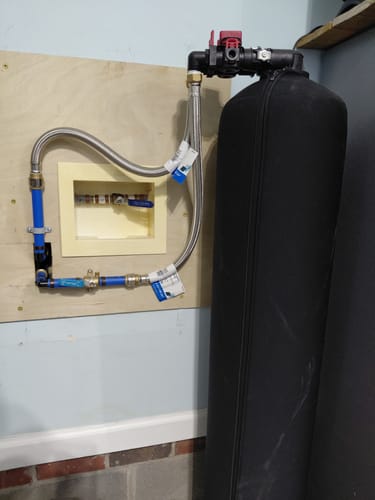
Everything was included: the main filter housing, mounting bracket, pressure relief button, inlet/outlet fittings, and a comprehensive manual. The documentation was actually helpful – clear diagrams, proper specifications, and installation guidelines that didn't assume I was a professional plumber.
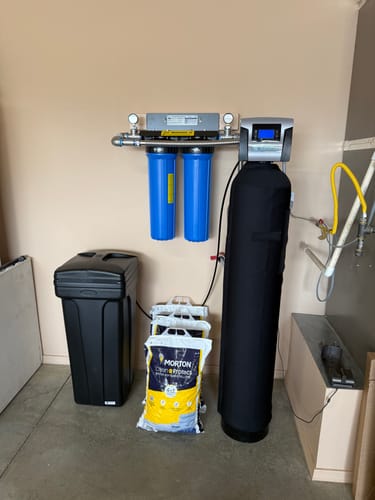
My first concern was the size. This system requires real space – not something you're tucking into a tiny utility closet. The housing stands about 20 inches tall and needs clearance for cartridge changes. I had to rearrange some items in our garage utility area to accommodate it properly.
The cartridge itself is impressively heavy – you can feel that it's packed with media, not just loosely filled. The bone char and catalytic carbon blend has a distinctive appearance, quite different from standard black carbon you might see in smaller filters.
Installation Reality Check

I opted for professional installation, and I'm glad I did. While I'm reasonably handy, this involves cutting into your main water line and installing bypass valves – not something I wanted to experiment with on a weekend.
The plumber spent about three hours on the installation. Most of that time was spent on proper positioning and ensuring adequate clearance for future maintenance. He installed a bypass valve system, which I now appreciate every time I need to change cartridges without shutting off water to the entire house.
The system integrates into your plumbing right after the main shutoff but before your water heater. This positioning ensures that both hot and cold water throughout the house gets filtered. The flow direction is clearly marked, and there's a mounting bracket that secures everything to the wall studs.
Initial startup was straightforward – flush the system for about 10 minutes to clear any carbon fines, then you're operational. The pressure drop was minimal; I measured less than 2 PSI difference between inlet and outlet pressure during normal flow conditions.
One installation tip I wish I'd known: position the system where you can easily access the pressure relief button and cartridge housing. You'll need this access for maintenance, and having adequate lighting in that area makes the process much more pleasant.
Performance Testing and Results
I tested the water before and after installation using TDS meters and chlorine test strips. While TDS isn't a perfect measure of water quality, it gives you a baseline for tracking changes over time.
The chlorine reduction was immediate and dramatic. Test strips showed virtually complete chlorine removal – down from 1.2 ppm to undetectable levels. The smell difference was noticeable within the first hour of operation.
For fluoride testing, I used a digital fluoride meter (borrowed from a friend who works in water treatment). Our municipal water typically runs between 0.7-0.9 ppm fluoride. After installation, levels dropped to around 0.2 ppm – not complete removal, but significant reduction.
The taste improvement was the most immediate change my family noticed. Coffee tasted noticeably cleaner, and my wife mentioned that ice cubes seemed clearer and didn't have that chemical aftertaste we'd gotten accustomed to.
Flow rate remained excellent throughout the house. Even with multiple fixtures running simultaneously – shower, dishwasher, and washing machine – I didn't notice any pressure issues. The system is rated for homes up to 4 bathrooms, and it delivers on that promise.
After six months of use, I retested everything. Performance remained consistent, with no noticeable degradation in chlorine removal effectiveness. The fluoride reduction had decreased slightly to about 0.3 ppm, but was still providing meaningful reduction.
Daily Life Impact and Family Benefits
The most unexpected benefit was what happened to our skin and hair. My wife's post-shower skin dryness virtually disappeared within two weeks. I hadn't realized how much the chlorine was affecting us until it was gone.
Our morning routines became more pleasant. No more opening faucets to that sharp chlorine smell, especially noticeable in our master bathroom first thing in the morning. Guests started commenting on how good our water tasted, which was gratifying validation.
Cooking improved in subtle but meaningful ways. Pasta water, rice, coffee – everything that involves significant water content just tastes cleaner. I'm not claiming it transformed us into gourmet cooks, but it eliminated that underlying chemical note that was always present.
The dishwasher performance improved too. Fewer water spots on glassware, and our stainless steel items come out looking cleaner. I suspect the reduced mineral content and absence of chlorine helps with the final rinse cycle effectiveness.
Even our houseplants responded positively. My wife's fiddle leaf fig, which had been struggling for months, started showing new growth within six weeks of the installation. Plants are sensitive to chlorine, and removing it from their water supply made a visible difference.
Laundry results improved as well. Clothes feel softer, and colors seem to stay brighter longer. We've actually reduced our fabric softener usage because the water itself feels less harsh.
Maintenance Reality and Long-Term Costs
The cartridge replacement interval is approximately 12-18 months, depending on your water usage and local water conditions. In Austin, with our moderate mineral content but high chloramine levels, I'm replacing cartridges about every 14 months.
Cartridge replacement is straightforward once you've done it the first time. Shut off the water supply, engage the pressure relief button, unscrew the housing, swap cartridges, and reverse the process. The whole operation takes about 30 minutes, including the initial system flush.
The replacement cartridges cost around $180 each. When you break that down over 14 months, it's roughly $13 per month to filter all the water coming into our house. Compared to what we were spending on bottled water and the under-sink system cartridges, it's actually economical.
I keep a maintenance log noting installation dates, water usage patterns, and performance observations. This helps me optimize replacement timing and track long-term costs accurately.
One maintenance tip: mark your calendar for cartridge changes. The system doesn't have electronic monitoring, so you're responsible for tracking service intervals. I set a phone reminder for every 12 months to start monitoring performance more closely.
Storage isn't a major issue – I keep one spare cartridge on hand, and it doesn't require special storage conditions. Room temperature in a dry location is sufficient.
Final Assessment and Recommendations
After 18 months of ownership, I'm genuinely satisfied with this investment. The system delivers on its primary promises: effective chlorine removal, meaningful fluoride reduction, and consistent whole-house performance.
This solution works best for households dealing with municipal water that has noticeable chlorine/chloramine treatment and fluoride addition. If you're on well water with different contamination issues, or if your main concerns are heavy metals or bacteria, you'd need different technologies.
The installation investment is significant – between the system cost and professional installation, you're looking at a substantial upfront expense. But the long-term operating costs are reasonable, and the quality-of-life improvements justify the investment for our family.
I'd recommend this system to homeowners who want comprehensive fluoride and chlorine removal without the waste and complexity of whole-house reverse osmosis. It's particularly valuable if you have family members with chlorine sensitivity or if you're concerned about fluoride exposure.
The main limitations are space requirements and the need for professional installation in most cases. This isn't a DIY-friendly solution for apartment dwellers or homes with severely limited utility space.
Looking back, I wish I'd made this change sooner. The daily benefits – better-tasting water, improved skin comfort, cleaner-tasting food – more than compensate for the investment. It's one of those home improvements that enhances your quality of life in small but constant ways.
For families prioritizing water quality throughout their entire home, specifically targeting fluoride and chlorine issues, this system delivers reliable, long-term performance. Just ensure you have adequate space, budget for professional installation, and commit to the maintenance schedule for optimal results.